
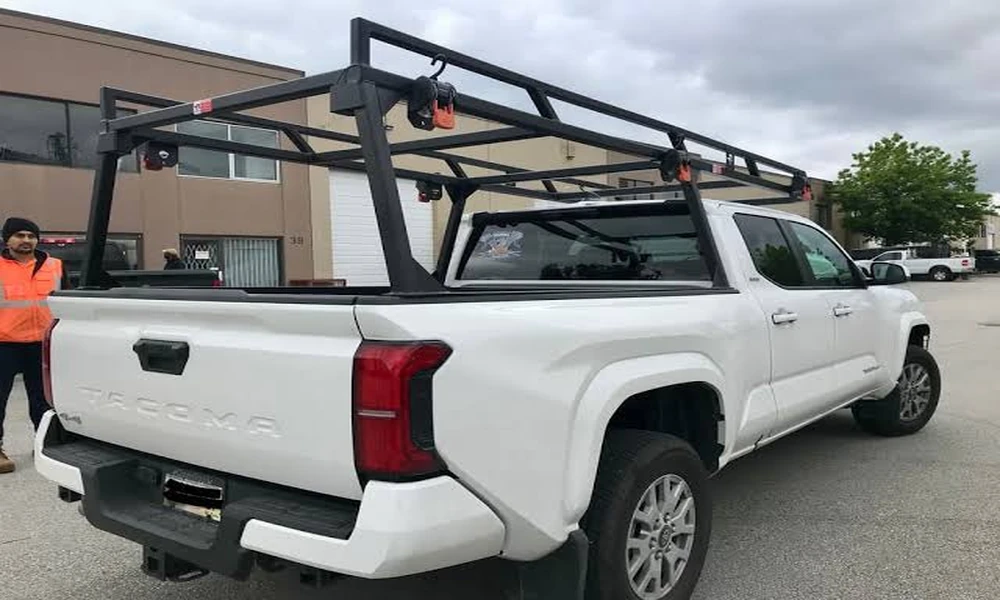
Picture a contractor on a Monday morning, sliding a 28-foot extension ladder, a bundle of conduit, and a stack of lumber overhead before the first job. Everything fits, the straps are tight, and the truck pulls out of the yard. Whether that load is actually safe is a separate question, and the label on the crossbar only answers part of it.
The number printed on a truck ladder rack tells you what the rack itself was built to carry. How much you can haul down the highway also depends on the truck underneath it, how the rack is mounted, and whether that number was measured parked or moving.
Typical Ladder Rack Weight Capacities
Most pickup ladder racks are rated between 250 and 1,000 pounds, and 800 pounds is the most common rating for full-size contractor racks. A rack’s rating within that range depends mainly on its design.
| Rack type | Typical rated capacity | Best for |
|---|---|---|
| Light-duty clamp-on rack | 250-500 lb | One or two ladders, kayaks, occasional loads |
| Adjustable two-crossbar bed rack | 500-800 lb | Daily trade use: ladders, pipe, lumber |
| Over-cab contractor rack | 800-1,000 lb | Long material and heavier distributed loads |
| Heavy-duty or service-body rack | 1,000 lb and up | Commercial fleets and full-time hauling |
Material matters less than many buyers expect. Aluminum and steel racks both commonly carry 800-pound ratings. Aluminum’s real advantage is that it weighs less, leaving more of your truck’s payload for cargo.
Static vs. Dynamic Load Ratings
A rack’s driving limit is its dynamic rating, which is always lower than its static rating.
- Static load is the weight the rack supports while the truck is parked.
- Dynamic load is the weight it supports while the truck is moving; braking, cornering, and bumps multiply the force on every bolt and clamp.
The gap between the two can be large. Published ratings include 1,100 pounds static against 800 dynamic on one rack, and 800 static against 400 dynamic on another. One topper-mounted rack lists 1,000 pounds static, 500 on-road, and 400 off-road.
Many manufacturers publish only one number, often the static one. If a listing doesn’t say which it is, ask before you load to the limit.
What Actually Limits the Load
The rack’s rating is a ceiling, and four other factors often set a lower one.
- Truck payload. Payload covers everything the truck carries: passengers, tools in the bed, trailer tongue weight, and the rack itself. Racks weigh roughly 40 to 100 pounds, and that comes off the top.
- Mounting method. A rack is only as strong as its connection to the truck. Clamp-on racks rely on the bed rails, and racks bolted to a tonneau cover’s T-slots are limited by the cover’s own rating.
- Weight distribution. Ratings assume the load is spread evenly across the crossbars. Concentrating weight on one bar or one side can overload it well below the listed capacity.
- Driving conditions. Rough roads and off-road trails increase dynamic forces, so the safe load drops further.
How to Find Your Real Limit
Your working limit is the lowest of three numbers: the rack’s dynamic rating, the mounting system’s rating, and your remaining payload.
- Find the rack’s rating in the manual and note whether it is static or dynamic.
- Read your truck’s payload from the Tire and Loading Information sticker on the driver’s door jamb.
- Subtract passengers, bed cargo, and the rack’s weight.
- Compare what’s left to the rack and mounting ratings, and use the smallest figure.
Here is an example. A truck has 1,500 pounds of payload. Two people (400 pounds), tools in the bed (500 pounds), and a 60-pound rack leave 540 pounds. Even with an 800-pound rack, the real limit overhead is 540 pounds.
Tips for Loading Safely
- Place the heaviest items in the center and spread the load across both crossbars.
- Tie everything down at two or more points with rated ratchet straps, and use the load stops.
- Check your state’s overhang rules. A red flag is commonly required once a load extends about 4 feet past the rear of the vehicle.
- Slow down in corners. Weight carried high raises the truck’s center of gravity.
- Re-tighten clamps and bolts regularly, since vibration loosens hardware over time.
Frequently Asked Questions
Can a ladder rack hold 1,000 pounds?
Yes, some over-cab and heavy-duty racks are rated for 1,000 pounds, distributed evenly across the crossbars. Your truck’s remaining payload and the rack’s dynamic rating still apply.
Is an aluminum ladder rack as strong as a steel one?
Often, yes. Many aluminum racks carry the same 800-pound rating as steel models while weighing less. Compare the published ratings rather than the material.
Does the rack’s weight count against payload?
Yes. The rack, its hardware, and everything loaded on it all count toward the payload figure on the door-jamb sticker.
What happens if I overload a ladder rack?
Overloading can bend crossbars, loosen clamps, and damage bed rails. It also lengthens braking distances and makes the truck less stable in turns.