
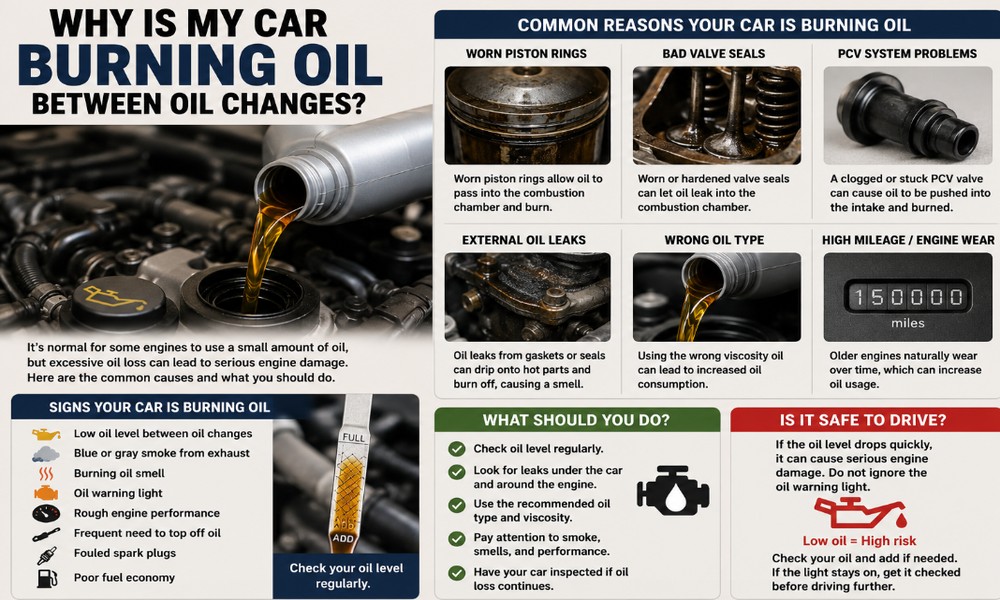
Noticing that your car is burning oil between oil changes can feel a little confusing. You get the oil changed, drive like normal, and then a few weeks later the oil level is low again. Maybe the warning light comes on. Maybe you check the dipstick and see the level has dropped. Or maybe you notice a burning smell after driving.
A small amount of oil use can happen in some vehicles, especially as they get older. But if your car is losing oil often, it should not be ignored. Engine oil protects the moving parts inside the engine. When the oil gets too low, friction increases, heat builds up, and expensive damage can follow.
The tricky part is that burning oil does not always leave an obvious puddle under the car. Sometimes the oil is leaking. Other times, it is being burned inside the engine.
What Does It Mean When a Car Burns Oil?
When a car burns oil, it means engine oil is entering the combustion chamber and burning along with the fuel. The combustion chamber is where fuel and air ignite to power the engine. Oil is not supposed to be part of that process.
Engine oil should stay in areas where it lubricates parts, reduces friction, and helps manage heat. If it slips past worn seals, rings, or other internal parts, it can burn during normal driving.
This may cause low oil levels, blue-gray smoke from the exhaust, poor engine performance, or a burnt smell.
Common Signs Your Car Is Burning Oil
The signs can be easy to miss at first. You may not see smoke every time you drive. Sometimes the only clue is that the oil level keeps dropping.
Common signs include:
- Low oil between oil changes
- Blue or gray smoke from the exhaust
- Burning smell after driving
- Oil warning light
- Rough engine performance
- More frequent need to top off oil
- Dirty or oily spark plugs
- Poor fuel economy
If the oil level keeps going down and there is no clear leak, the engine may be burning oil internally.
Worn Piston Rings
Worn piston rings are one of the common reasons a car burns oil. Piston rings help seal the space between the piston and the cylinder wall. They keep oil out of the combustion chamber and help maintain engine compression.
Over time, these rings can wear down. When that happens, oil can slip past the rings and burn with the fuel. This often causes blue smoke from the exhaust, especially during acceleration.
Worn piston rings are more common in older vehicles or engines with high mileage. They can also happen sooner if the engine has not been maintained well.
Bad Valve Seals
Valve seals help control oil around the valves in the engine. If these seals become worn, cracked, or hard, oil can leak into the combustion chamber.
Bad valve seals may cause smoke when you first start the car, especially after it has been sitting for a while. You may also notice smoke after idling and then accelerating.
This problem can be subtle at first. The car may still drive normally, but the oil level slowly drops over time.
PCV System Problems
The positive crankcase ventilation system, often called the PCV system, helps manage pressure inside the engine. It also routes gases back into the intake system to be burned.
If the PCV valve gets stuck or clogged, pressure can build up. This can push oil into places it should not go. In some cases, the engine may start using more oil than normal.
The good thing is that PCV problems are often easier and cheaper to fix than major internal engine wear. That is why it should be checked before assuming the worst.
External Oil Leaks That Burn on Hot Parts
Sometimes a car is not burning oil inside the engine. Instead, oil is leaking outside the engine and dripping onto hot parts, like the exhaust manifold.
This can create a strong burning smell. You may not see a puddle because the oil burns off before it reaches the ground.
Common leak points include:
- Valve cover gasket
- Oil pan gasket
- Timing cover gasket
- Oil filter housing
- Drain plug
- Rear main seal
If you smell burning oil but do not see smoke from the exhaust, an external leak may be the cause.
Using the Wrong Oil
Using the wrong oil viscosity can also lead to oil consumption. If the oil is too thin for your engine, it may slip past seals or rings more easily.
Always use the oil type recommended for your vehicle. Some engines are designed for specific oil weights. Using the wrong one may affect protection, performance, and oil use.
This is especially important for high-mileage vehicles. Older engines sometimes need oil that is better suited to worn seals and higher operating temperatures.
Is It Safe to Drive a Car That Burns Oil?
It depends on how much oil it is burning. If the oil level drops slightly over a long period, you may be able to manage it by checking and topping off the oil regularly. But if the oil level drops quickly, driving can be risky.
Low oil can cause serious engine damage. Parts inside the engine need constant lubrication. Without enough oil, the engine can overheat, knock, seize, or fail.
If your oil warning light comes on, do not ignore it. Stop safely, check the oil level, and add oil if needed. If the light stays on, the vehicle should be inspected before driving farther.
What Should You Do First?
Start by checking the oil level regularly. Use the dipstick when the engine is cool or after the car has been parked for a few minutes, depending on your vehicle’s instructions.
Next, look for leaks under the car and around the engine. Also pay attention to smoke, smells, and when the problem happens.
Helpful questions include:
- Does smoke appear during startup?
- Does smoke appear during acceleration?
- Do you smell burning oil after driving?
- How often do you need to add oil?
- Is there oil on the ground?
- Was the correct oil used during the last oil change?
These details can help identify the cause faster.
Final Thoughts
A car burning oil between oil changes is a warning sign. It may be something simple, like a PCV issue or small leak. It may also point to worn piston rings, bad valve seals, or other internal engine problems.
The best thing you can do is not wait too long. Check the oil level often, use the right oil, and have the issue inspected if the level keeps dropping. Catching the problem early can help protect the engine and prevent bigger repairs later.
This post was written by a professional at Tires2Go Florida. Tires2Go Florida is a trusted automotive service center located in Pinellas Park, Florida, serving drivers across St. Petersburg, Tampa, Clearwater, and Largo. Our certified mechanics handle tire and wheel replacement, brake service, suspension repairs, oil change Tampa, wheel alignments, tire balancing, and road force balancing. We also specialize in ADAS calibration, suspension modifications, lift kits, and lowering kits using quality parts and modern diagnostic equipment. From routine maintenance to advanced automotive services, Tires2Go Florida provides dependable solutions and tires for sale for vehicles throughout the Tampa Bay area.